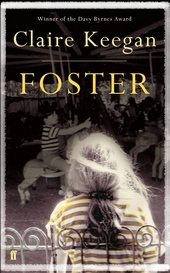
"Claire Keegan
Foster
For Ita Marcus
and in memory of David Marcus
1
Early on a Sunday, after first Mass in Clonegal, my father, instead of taking me home, drives deep into Wexford towards the coast where my mother’s people came from. It is a hot day, bright, with patches of shade and greenish, sudden light along the road. We pass through the village of Shillelagh where my father lost our red Shorthorn in a game of forty-five, and on past the mart in Carnew where the man who won the heifer sold her shortly afterwards.
My father throws his hat on the passenger seat, winds down the window, and smokes. I shake the plaits out of my hair and lie flat on the back seat, looking up through the rear window. In places there’s a bare, blue sky. In places the blue sky is chalked over with clouds, but mostly it is a heady mixture of sky and trees scratched over by ESB wires across which, every now and then, small, brownish flocks of vanishing birds race.
I wonder what it will be like, this place belonging to the Kinsellas.
I see a tall woman standing over me, making me drink milk still hot from the cow. I see another, less likely version of her in an apron, pouring pancake batter onto a frying pan, asking would I like another, the way my mother sometimes does when she is in good humour. The man will be her size. He will take me to town on the tractor and buy me red lemonade and crisps. Or he’ll make me clean out sheds and pick stones and pull rag-weed and docks out of the fields.
I see him pulling what I hope will be a fifty-pence piece from his pocket but it turns out to be a handkerchief. I wonder if they live in an old farmhouse or a new bungalow, whether they will have an outhouse or an indoor bathroom with a toilet and running water. I picture myself lying in a dark bedroom with other girls, saying things we won’t repeat when morning comes.
An age, it seems, passes before the car slows and turns into a tarred, narrow lane, then a thrill as the wheels slam over the metal bars of a cattle grid.
On either side, thick hedges are trimmed square. At the end of the lane there’s a long, white house with trees whose limbs are trailing the ground.
‘Da,’ I say. ‘The trees.’
‘What about ’em?’
‘They’re sick,’ I say.
‘They’re weeping willows,’ he says, and clears his throat.
In the yard, tall, shiny panes reflect our coming.