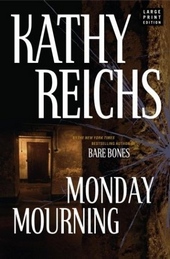
Monday Mourning читать онлайн
- Жанр: Легкое чтение, Детективы, Триллеры
- Рейтинг: 0 баллов
- Мнений: 0 мнений
- Просмотров: 17 чтений
Текст книги
There’s only about one radiocarbon atom for every trillion stable carbon atoms. Radiocarbon is constantly being created in the upper atmosphere by cosmic bombardment of nitrogen. Some of the nitrogen converts to radiocarbon, which immediately oxidizes to CO2. That CO2 works its way down into the biosphere, where it’s taken up by plants. Since humans, animals, and plants comprise the same food chain, as long as they are alive they have a constant amount of radiocarbon in them. The actual amount is gradually decreasing due to radioactive decay, but is being replenished through food intake, or through photosynthesis in the case of plants.
LaManche raised both palms in a gesture of skepticism. “Five-thousand-plus years. How can such a slow process be of value with recent remains?”
“A fair question.
“How so?”
“That’s where it gets interesting. Studies have documented significant anomalies in radiocarbon data for certain time periods.
LaManche leaned back, interlaced his fingers, and laid his hands on his chest. A hint for brevity? I did some mental abridgment.
“The period from about 1910 to 1950 is characterized by a decrease of atmospheric radiocarbon, probably due to the release into the atmosphere of the products of combustion of fossil fuels such as oil, coal, and natural gas.
“Why?”
“Because of their great age, fossil fuels contain no detectable radiocarbon. They are said to be dead. Since the combustion of these fuels releases carbon dioxide devoid of radiocarbon, the relative amount of Carbon 14 in the atmosphere drops.”
“Oui.”
“But beginning about 1950, the atmospheric testing of thermonuclear weapons reversed this downward trend.”
“The radiocarbon in living things increased.”
“Dramatically.